

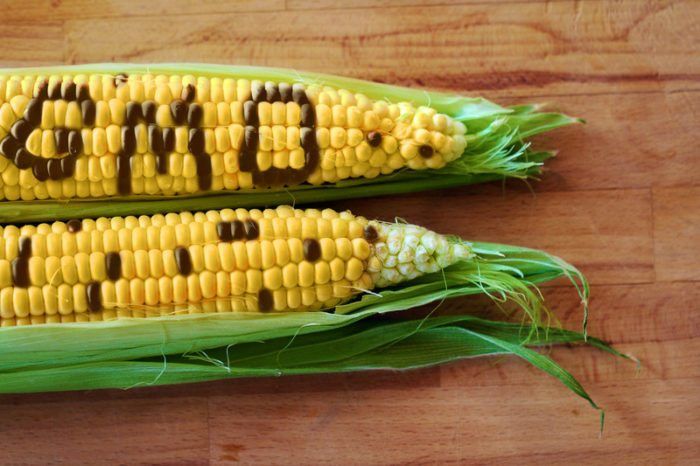
Organic foods are, by definition, non-GMO. However, the GMO controversy is larger than the organic debate – leading to a separate discussion.
The GMO dispute sings a different verse to the same song we’ve heard with the other nutritional arguments. Opponents raise valid concerns, but blow them out of proportion, making fear claims without evidence. Proponents make safety assurances, also without evidence, which don’t tell the whole story.
 Background
Let’s start with a definition and an outline of the opposing views.
GMO stands for Genetically Modified Organism, which is an organism altered by inserting a gene from the DNA of another organism to give the modified organism some desired trait.
We are not talking about simple plant breeding. Since the “new” gene can be sourced from bacterium, plant, virus, or animal, the process takes place in a laboratory using methods not available in nature (creating technologically advanced hybrids, as some would say).
The GM crops currently on the market are primarily engineered to increase resistance to diseases and/or tolerance to herbicides. About 90 percent of all corn, soybeans, cotton, sugar beets, and canola grown in the United States is genetically modified with these traits.
Other GMO crops available in the U.S. are papaya, alfalfa, and summer squash.
 While other potential benefits exist, “golden rice” (vitamin A-enhanced rice) seems to be the shining example of humanitarian effort in the GMO portfolio.
Most scientists acknowledge a need for more research and careful study when developing new organisms. Analysts know genetic engineering can result in unintended consequences, such as disruption to ecosystems or adverse health effects to animals or humans.
However, the fact remains that no long-term testing has been performed. Most statements about the harm and safety of GMO’s are based on scientific deductions – nothing has been proven on either side.
Opponents claim GMO’s pose a significant allergy risk, are contributing the antibiotic resistant diseases, and increase cancer risk (by way of increased herbicide use). All these concerns are based on sound scientific reasoning, but none have been proven by scientific research.
Much concern also stems from the fact that chemical companies are the major manufacturer of GMO plants. We have the leading developer, Monsanto (creator of Agent Orange and RoundUp), as well as DuPont, Dow Chemical, and Bayer as the major players . . . doesn’t exactly give me warm, confident feelings. And while a stated goal is reduced herbicide and pesticide use (Really? The chemical companies want to reduce demand for their product? Hmmm), the actual effect has been heavier herbicide spraying.
Some other theoretical concerns are the potential mutation of plants, resulting in a super, herbicide-resistant weed; or the decrease in genetic crop diversity leading to a potentially vulnerable strain.
What DO We Know?
We know genetic modification of DNA results in modified proteins, so GMO foods and foods made from GMO protein sources can cause food allergies. If a protein from an organism that causes an allergic reaction is added to a food that previously didn’t, a new allergic reaction can result.
 The CDC reports food allergies in children under 18 have increased from 3.4% between 1997 and 1999 to 5.1% between 2009 and 2011.
Are the two facts connected? It is possible (maybe even probable), but the connection has not been researched.
We know scientists often modify seeds using antibiotic-resistant genes. Is there a link between these modifications and the rise of antibiotic resistant bacteria? Again, it makes sense. The reasonable concern should be studied. But proponents, for now, are happy to proclaim no evidence supports the allegation.
We know herbicides are hazardous to human health. Manufacturers have conceded the point, moving on to claim levels consumed by humans are safe. As we mentioned during the organic discussion, some are happy to accept the chemical industry assurances, while others believe limiting exposure should be a top priority.
While concerns about GMO safety are reasonable, assurances of safety may also be reasonable. The problem is lack of research. Neither side has proven their point. Research costs money and no financial incentive exists for companies to fund these types of studies.
GMO’s in Other Products
A large portion of the major GMO crops (corn, soybeans, cotton, sugar beets, and canola) are further processed to create other products, like high-fructose corn syrup, flours, oils, milks, tofu, and molasses. Even more processed foods contain ingredients taken from GMO plants, such as soy protein, soy lecithin, dextrine, maltodextrine, glutamate, enzymes and many vitamins.
While GMO opponents claim all food items sourced from GMO plants carry equal risk, science does not support this view. Since the modified gene resides in the protein, any process that destroys or excludes the protein also removes the modification. In other words, purified sugars, oils, vitamins, and nutrients derived from GMO crops are both biologically and chemically identical to those sourced from non-GMO plants . . . because they do not contain DNA.
Does “non-GMO” matter when choosing a protein powder? Yes. Does “non-GMO” matter when choosing canola oil (or any oil for that matter)? No.
The critical piece of information when considering GMO or non-GMO food products is whether protein is present in the end product.
What About Meat and Eggs?
Most GMO produce in the U.S. is consumed by our meat supply. So, as we discussed Organic/GMO crops, we touched on meat and poultry as well.
The findings about beef and poultry mirror the milk studies.

Animals consuming GMO sourced feed will certainly pass along herbicides, antibiotics, and hormones to the end consumer – and as a result many choose organic. Others claim the contaminant levels are safe for humans. The safety question falls to the consumer’s judgment call.
But, as we discovered with milk, organic meat contains 50% more omega-3s than conventional meat, and organic eggs contain twice the omega-3s, as well as lower cholesterol and saturated fats than conventional eggs.
Once again, price comes into play.
And, once again, consider the budget – the risks – the benefits – and the quantities consumed.
The Environment
Another aspect of the organic-GMO question is environmental responsibility. Both sides claim the moral high-ground regarding sustainability of global farming. I have completely sidestepped that debate because I believe it distracts from the most reasonable environmental solution – which I have previously presented – vegetarianism.
 Wrap Up
As we end the series on confusing and controversial health topics, I want to refer back to the opening post and reiterate; nutritionists agree more than they disagree. We know what a healthy diet looks like. It is far more important to incorporate basic healthy choices into our lifestyle than to bicker and argue over some confusing topics (or worse yet, to abandon a healthy lifestyle out of frustration). I hope the research here has been helpful in sorting out fact from fiction.
 RSS - Posts