

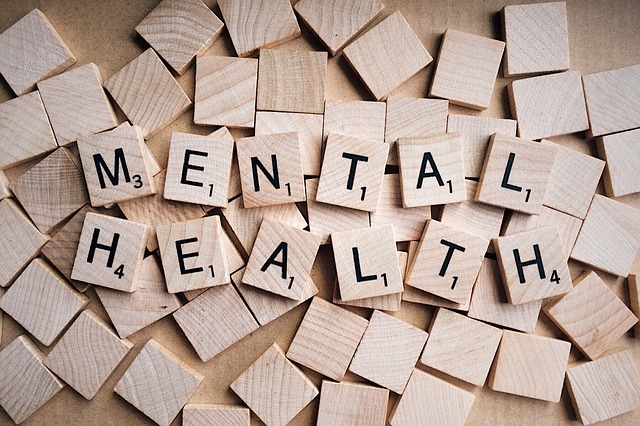
 May is mental health awareness month (among other things).
Thirty years ago mental illness was not on my radar. I only thought of ill people as strange and scary. Until, as so often happens, mental illness affected someone I loved.
I talk on my personal blog about my experiences with my husband’s PTSD and addiction. I learned much more than I ever wanted about mental illness, addiction, and co-dependence. While I know and accept that our family is in fact strange, we are not really scary most of the time. Avoiding us is not as necessary as you might think.
But this blog is about health and nutrition. I decided to take a look at how nutrition affects mental health. Although the topic has been around a while, few seriously consider nutritional interventions when it comes to mental illness.
Brain health is wrapped in a lot of emotion. We believe we control our brains, rather than the other way around, more so than other body parts.
For instance, friends and family rarely suggest we repair a broken bone by will-power or expect an injured person to accomplish tasks as if the bone were not broken. But this is a common experience for people with mental illness. The thing is, bones don’t play a part in decision-making or behavior – so we more readily accept the disability and limitations.

Long-term and/or permanent conditions also make us uncomfortable. When dealing with a broken bone, the patient will (most likely) follow the prescribed treatment for roughly six weeks, the bone will heal, and everything is happy again.
Mental illnesses are rarely curable. Most can be successfully managed – but not 100% healed.
But, unlike a century ago – or even half a century ago, people with mental illness have resources available to create more happy and productive lives. And even the person with a broken bone would be considered irresponsible for ignoring medical treatment – refusing a cast, or removing it to soon (ahem. . . something my husband did in the military!)
While we can’t will our brains to be healed any more than we can will a broken bone to be mended, we can in both cases take steps toward restoration. The prognosis may differ but the method is the same.
 Knowledge of how nutrition affects mental health is expanding.
Studies clearly prove that diets high in fruits, vegetables, unprocessed grains, and seafood – with small amounts of lean meat and dairy, and little to no processed foods and sugars – result in lower levels of depression, stress, and anxiety, even among those suffering from serious mental illnesses such as bipolar disorder.
I have previously discussed omega 3, magnesium, and vitamin B for those dealing with bipolar disorder, as well as nutritional interventions for ADHD, so I won’t cover the same ground again. I would only add that mental health professionals are taking notice of the brain’s need for proper nutrition when treating mental illness.
“It makes sense. If your brain is deprived of good-quality nutrition, or if free radicals or damaging inflammatory cells are circulating within the brain’s enclosed space, further contributing to brain tissue injury, consequences are to be expected.” – Eva Selhub M.D., Harvard Health Publications

The investigation into nutrition’s role in mental health led microbiologists and neuroscientists to explore a newfound link between gut health and brain health.
“The gut and brain have a steady ability to communicate via the nervous system, hormones, and the immune system. Some of the microbiome can release neurotransmitters, just like our own neurons do, speaking to the brain in its own language via the vagus nerve. – Emily Deans M.D., Psychology Today
Scientists have found problems with the digestive system may play a part in simple mood disorders like anxiety and depression, severe psychosis such as schizophrenia or bipolar disorder, and a variety of neurological problems like Parkinson’s disease and dementia. Some findings even suggest some non-genetic cases of autism might be the result of gut inflammation – and improved with beneficial bacteria.
 These developments are in early stages, but I think we have enough information to make gastrointestinal health a priority – particularly when mental illness is in the picture.
And good healthy habits benefit our brains. So, get plenty of exercise and rest, keep hydrated, avoid sugar and processed foods, eat your vegetables, and take your vitamins! (Sorry, the mom in me escaped for a minute) It might not cure you – but your illness (mental or otherwise) will be more manageable.
 RSS - Posts